Friday, April 21, 2023

My Pitiful Returns from my Investment Linked Policy after 17 Years

So I recently terminated my Investment Linked Policy (ILP), in order to provide $$$ during my upcoming sabbatical. 

This ILP was started 17 years ago when I was still a young man.

From time to time I recorded the surrender value and how much I paid thus far, in order to figure out the returns. The returns here are calculated using the fv() function in Google Sheet and is equivalent to CAGR or time-weighted rate of return. 

ILP returns

The maximum return was only 4% in 2018!!

What is more, during the Covid-19 recession of 2020 the returns were 0%.

The returns were disappointing, to say the least. Hence I decided to terminate the policy while the returns were still positive at 1.9%.

This is also taking into account that there is more and more talk of an upcoming recession in 2023, such as those below:

https://www.cnbc.com/video/2023/04/14/singapore-cant-avoid-a-recession-economist-says-.html

https://www.straitstimes.com/business/ceos-delay-and-halt-investments-expect-upcoming-recession-survey

I will also share something which I believe is a totally inadequate effort on Income's part. In the portal, they only shared the simple returns but not the time-weighted returns. This is totally inadequate. Folks not versed in finance will believe their returns are great from the below, which shows 20.98%. They will think: Oh! Better than bank returns! That is wonderful!

In actual fact, after taking into account compounding effects, the returns are merely 1.9%...


Also, I looked at the performance of the fund versus its benchmark:


It says 10-year returns are 7.21% since inception returns are 5.96%. Incredulous! No idea where these numbers come from. Likely it is before fees are deducted. I certainly didn't get these returns with my hard-earned money, I only got 1.9% after 17 years.


Saturday, April 15, 2023

Taking a Gap Year

This article popped up in my feed today:

https://www.businessinsider.com/what-its-like-to-career-break-gap-year-resume-gaps-2023-4

I think it is worth a read.

The author has always wanted to write a book. She tried doing it while she was working, but could not manage due to other commitments such as family, work, etc. She summed it up best in:

Unfortunately, I just couldn't find the discipline to also be a good writer. And so, I felt like I needed to not be working at my job anymore. 

Finally, she made her decision:

I decided to prioritize my family and my dream of writing, and I handed in my notice in December 2022. 

Three months into her gap year, she quipped:

The pace of my day is so much slower now, and the freedom of that is shocking. I hadn't realized how much tension I'd been holding in.

I feel this pretty much mirrors my situation as well, except I have more things I want to do than her. 

Sometimes once you have prepared all you can, you just have to take a leap of faith. 

Take risks, dream big. 

Friday, April 7, 2023

Dividends for Mar 2023 [Financial Independence]

  Here are my dividends for Mar 2022:


So I collected $1,465.60 in dividends for Mar 2023. 

In case you are wondering, some stocks are repeated because I have 2 brokerage accounts. 

Here are my monthly dividends over the last 5 years:


Here are the dividends I collected every year until the current day:


Onwards!

Friday, March 31, 2023

My Prediction of the S&P500 was 100% Accurate!

Around one month ago I drew the below chart in this post: http://financeopti.blogspot.com/2023/02/state-of-s-and-sti.html (note the hand-drawn arrow on the right):


It turned out that after one month the market moved exactly as in accordance with the arrow I drew above!


Since the S&P500 broke through the downtrend resistance, there should be more upside to come in the short term.

As for the STI, this is the chart from one month ago:


Here's what I said one month ago about the STI: 

It recently broke through the resistance level at 3302. Also, there is a bearish crossover of the 10 and 50 day simple moving average. Room for further fall, before a rebound. 
It turns out that is exactly what happened - the STI fell to around the 3100 level before re-bounding:


Good news is that the 10 day simply moving average just cut the 200 day simple moving average from below, which indicates a bit more upside in the next few days. 

Woohoo!

Saturday, March 25, 2023

Breaking Free: I have achieved FINANCIAL INDEPENDENCE 3.0!


I have achieved the FI 3.0 target I set for myself. Let me share my journey to get to this point:

I achieved FI (Financial Independence) 2.0 in Jun 2021.

I have been aiming for FI 3.0 since Dec 2021 (see this post: http://financeopti.blogspot.com/2021/12/revisiting-my-fi-fi30.html).

Firstly, a recap of what is FI 3.0. It has a few buffers baked in:

  • CPF is not included in the Starting Balance - this is the first buffer
  • The withdrawal rate is reduced from 4% to 3% - this is the second buffer
  • Certain expenses are assumed to last till perpetuity, even if it may not be the case. An example is children's class fees. 

Below is the amount I have accumulated up to now:


Which is more than the 'Required Savings' necessary for FI:


In other words, I have achieved FI 3.0!!

I have started this journey ever since I completed my graduate studies. Roughly, it took me 11 years to get to this point. 

I just want to share some practices that helped me get to this point:
  • I own only 1 property - my HDB flat, which is my matrimonial home
  • No car
  • I use freebies whenever possible - my watch is free, my shoes are free, and my bag and jacket are given free from my previous companies
  • For 2 years, I took MRT to work at unearthly hours (exit station before 7.45am) to spend $0 on transport
  • Side hustles - I took up side hustles including food delivery, paid surveys, writing 2 blogs (one technical blog and one FI blog)
  • I do repayments to my mortgage loan regularly - now my loan has only ~$950 remaining
  • I invest regularly - in stocks and bond
  • Whenever I get upset at work, I keep in mind I have a bigger goal in my life - to achieve FI and I endured it to get to this point
In hindsight, some points above actually didn't help much on my FI journey (paid surveys paid peanuts for example), but they helped build the discipline and the conviction I needed to achieve FI. No regrets.

What's next for me? Well, I plan to take a sabbatical (minimum 9 months) from my present company.

Here are some of my reasons for taking a sabbatical:
  • Be able to sleep better at night - e.g. for the past week I can't get to sleep until after midnight, or very often I wake up 2-3am, think about work, and then am not able to get back to sleep
  • I burst the income ceiling for BTO long ago - by taking a sabbatical, I will draw no CPF, which will qualify me for our dream 5-room BTO
  • Issues at work - unsupportive and unhelpful colleagues that only care about themselves, not enough support from bosses, too many whiners and complainers at work thus creating a toxic environment, etc. Typical work gripes I guess
  • Real-life test of my FI expenses - all my expense calculations to date are based on when I am still working full-time. Will my expenses stay the same after I stop working full-time? Only by stopping full-time work will I know for sure
  • Find time to work on my technical blog
  • Find time to create more quality articles for my FI blog (yes, this blog)
  • Find time to spend more quality time with my kids e.g. if my kid is sick, he can stay at home instead of going to my parent's place, or I can avoid a scenario whereby I have to juggle taking care of him and working at the same time
  • Find time to do some self-study
  • Find time to rest more - I got too many comments from colleagues and family that I look tired over the past few years. I want to do something about it by finding time to get proper rest and doing something that I am truly passionate about
  • Find time to start exercising more regularly instead of just once a week - need to take care of my health. Now in my 40s, health issues are starting to pop up: eyesight not good, catch bugs easily, knee pain, etc. 
  • Find time to have the freedom to travel a bit further to get a good lunch instead of eating the same stuff around my neighborhood because I have to get back to work 
  • Find time to do volunteer work and help the community - I find this to be meaningful
  • Find time to be closer to nature - will like to go for regular nature walks and not have to take leave to do so
  • Find time to do some administrative things - writing my will, fixing my laptop, and changing to a cheaper phone plan are some of them
  • Find time to launch my startup. Yes! I have many ideas! Now that I am FI, coupled with my work experience over the past few years, there is no better time to start!

Do you have any questions for me? Ask below!

Saturday, March 18, 2023

Maximizing Your Retirement Pot: How to Top Up Your CPF

So CPF changed the layout of their website again, which probably left some users confused.

In this article, I will show a step-by-step guide to topping up your CPF Special Account (SA).

On the CPF website https://www.cpf.gov.sg/, first log in using your Singpass.

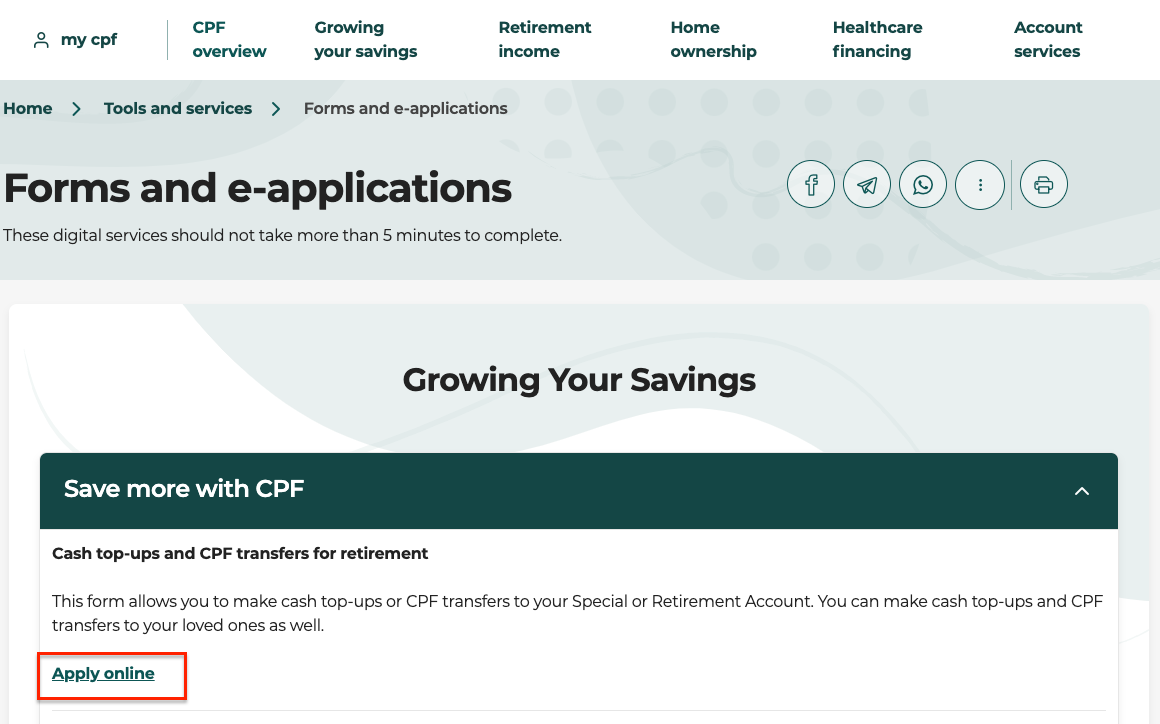
Next navigate to 'Tools and services' - 'Forms and e-applications', as below:


Next under 'Save more with CPF', click 'Apply online':


Useless page below, simply click the checkbox and 'Start':


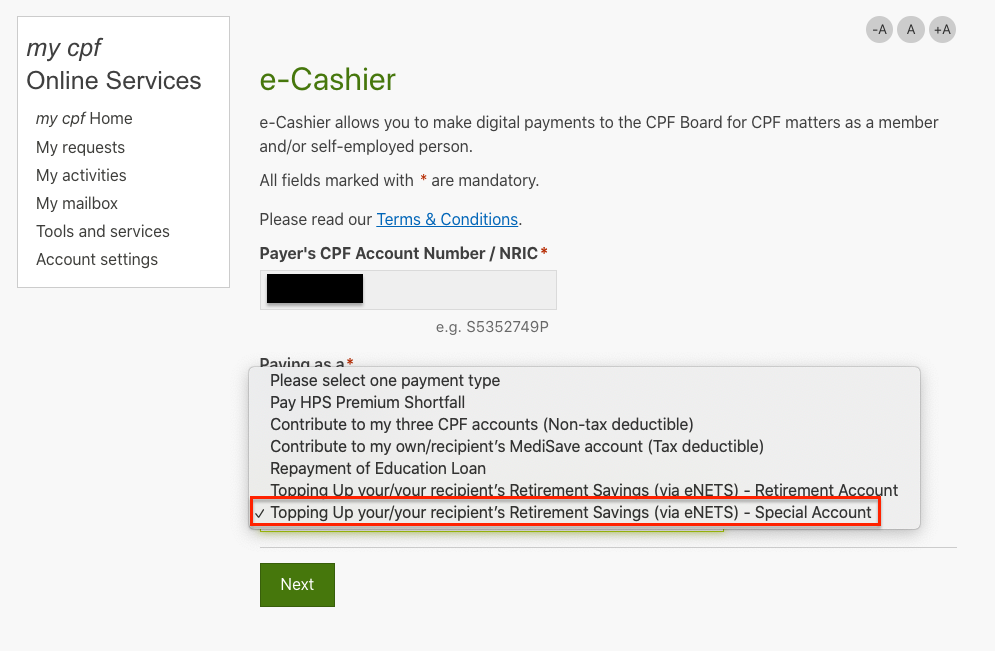
Choose the option to top-up, for me I chose 'Cash top-up via eNETS':

Next, you are directed to another useless page, but make sure the selection is correct as below:

Another bunch of stuff to read, click the checkbox and 'Start' (again!):

Fill up the boxes below, and once done click 'Next':


Check what you entered is correct, then click the checkbox and 'Next':

Select your bank and top-up via eNETs:

For me, the flow ended at my bank's website. Wish it will send me back to CPF to complete the flow:


Thats it! Totally convoluted flow, wish CPF gets a proper UX team!


Sunday, March 12, 2023

Silicon Valley Bank Collapse: Your Questions Answered

In this post, I try to understand the collapse of the Silicon Valley Bank, since this is a historical event. Answers are generated by Bing with minimal editing on my part. 


What caused the Silicon Valley Bank to collapse?

SVB failed on March 10, 2023, after a bank run and a capital crisis. It was taken over by federal regulators. It was the largest bank failure since 2008.


What is a bank run?

A bank run is when many customers withdraw their money from a bank at the same time because they fear that the bank might fail. This can make the bank insolvent and unable to pay back its depositors. 


How did the rise in interest rates cause depositors to withdraw their money?

SVB was vulnerable to a rise in interest rates because it had invested heavily in tech stocks and bonds that lose value when rates go up. When the Federal Reserve announced a rate hike on March 9, 2023, investors panicked and sold off SVB shares, causing its stock price to plummet. This triggered a loss of confidence among depositors who rushed to withdraw their money before the bank ran out of cash. 


Why did SVB make a massive loss of US$1.8 billion on its investments?

SVB made a massive loss of US$1.8 billion on its investments because it had to sell a large portion of its bond portfolio at a lower price than it bought them. This was because SVB needed to raise cash quickly to meet the demands of depositors who were withdrawing their money. The bond prices had fallen due to higher interest rates. 


Why do bond prices fall when interest rates rise?

Bond prices fall when interest rates rise because bonds pay a fixed amount of interest that becomes less attractive when new bonds offer higher interest rates. This lowers the demand for existing bonds and reduces their market value. 


What is the impact of the SVB collapse on other companies?

The impact of the SVB collapse on other companies is still uncertain, but some possible effects are:


  • Some Chinese firms that have business ties with SVB said they have seen limited impact so far, but some analysts warned about global risks
  • Some Israeli tech companies that relied on SVB for funding and banking services may face difficulties or losses
  • Some U.S. tech stocks and bonds may lose value as investors lose confidence in the sector


What are the companies that deposited the most money in SVB?


The exact list of companies that deposited the most money in SVB is not publicly available, but some of them are:


  • Roku, which said it has nearly $500 million with SVB
  • Roblox, which said it has about $300 million with SVB
  • Nazara Technologies, which said its two subsidiaries hold cash worth $8.7 million in SVB


These companies are among the 90% of SVB's depositors who have more than $250,000 with SVB and are not fully insured by the FDIC.

Without access to their deposits, these companies are unable to pay their employees!


What are the banks that experienced a bank run in the 2008 financial crisis?

One of the banks that experienced a bank run in the 2008 financial crisis was Washington Mutual, which collapsed in September 2008 and was acquired by JPMorgan Chase. Another bank that faced a bank run was Northern Rock in the UK, which was nationalized by the British government in February 2008. 

However, the most recent bank failure is Silicon Valley Bank. This is the largest failure of a financial institution since Washington Mutual more than a decade ago.


References

https://www.businesstimes.com.sg/companies-markets/how-bank-run-closed-svb-and-where-could-lead